Clock

New Delhi

Video Bar

Loading...

Daily Calendar

Thursday, August 5, 2010

BRING THE LAWYERS TO LAW

Who will bring the lawyers to law?
The unprecedented acts of hooliganism and vandalism done by the lawyers of the Madras High court has raised the issue that as Policing the Police is becoming gradually difficult, similarly bringing lawyers to the law is becoming an arduous task.
The lawyers were protesting against an attempt by the police to arrest some accused in connection with a complaint lodged by Subramanyam Swami. The lawyers turned violent and started attacking the police. They set ablaze some vehicles parked in the campus. Subsequently the Police also resorted to lathi charge and beat lawyers mercilessly.
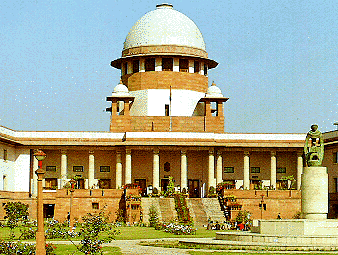
The lawyers went on strike and demanded action against what they call the brutal action of the police. The repeated request by the Supreme Court to the lawyers to call off their strike went unheeded.
The apex court appointed one man panel to probe into this episode headed by retired SC Judge B.N.Srikrishna. The panel submitted its 22 page report to the court and was read out in the court by some senior advocates.
The report has deplored the incident which took place on 19th February in the court premises of Madras HC. Srikrishna has termed the action and behaviour of the advocates as ‘hooligans and miscreants’
It is shame on our judicial system. Lawyers are the part and parcel of the entire criminal justice system and the courts cannot function without the participation of the advocates.
In recent times, a section of lawyers have formed an idea that they can take law in their hands and will go unscathed because they are under illusion that they are running the courts and the courts will not take action or allow any action to be taken against them.  The report has rightly indicted the acting Chief Justice of Madras High Court because his infirm and indecisive attitude allowed the situation to go from bad to worse. 
Few days ago, similar incident, though of smaller magnitude and intensity took place inside the court room at Patna High Court.  The Judge Mr. D.D. Jha was force to withdraw his order of making arrest of a lawyer for his act of contempt of the court.  The said advocate shouted at the highest pitch and called all his companion lawyers. They started slogans inside the court room before the Judge and the Judge could not nothing accept left the chair helplessly and withdrew his order.  Only few days before this incident, a section of lawyers and lawyer’s clerk raised slogans against the Chief Justice because the Chief Justice had issued one direction which necessitated the lawyers or the lawyers clerks to verify the stamps, they are furnishing with.  This order was made in view of detection of a racket which had been using fake stamps inside the court itself.  In this scam, the police said that the involvement of some advocates was allegedly possible.  Any way the entire stalemate could only be resolved when this order was withdrawn. 
Such types of infirm and indecisive attitudes of the court have emboldened the lawyers who have started taking law in their hands. 
 The report of Justice Shri Krishna has rightly sought the intervention of the apex court. The panel has also suggested framing of certain guide lines for the bar.  In fact there is no rule whatsoever in this matter and it is the bar council which regulates the activities of the advocates in India.  Of course there is one advocates Act, 1971, which gives certain broader guide lines for the lawyers, but it is becoming ineffective. 
The Parliament should, now come up to take up and tackle this dangerous trends which is spreading like a pandemic contagion in Indian Judiciary.  The time has come to frame a strict, elaborate and comprehensive   law in order to ensure that such ailment is cured, and cured forever. 

Saturday, May 29, 2010

BIHAR LAND POLICY ON ANVIL


BIHAR WATER POLICY ON ANVIL
Bihar is a land of paradoxes. The northern part of the state is flooded with both under and surface water whereas; the southern and central part of the province not so lucky and richly endowed with this resources. But at the same time the north Bihar bears almost invariably every year the brunt of rivers like Kosi, Adhwara groups, Bagmati, Kamal balan etc. the districts falling under this region experience wrath of the virulent and furious rivers every year leaving hundreds dead and extensive damages. This year also, the state is marked by this dichotomy and paradox. The 26 districts of central and north Bihar have been declared drought hit whereas about 6-7 districts have been facing wraths of flood fury. The people of Bihar have accepted this state of affairs as nature’s injustice to them, but government, this time, seems determined to fight to finish this natural calamity once for all.
It is therefore and under this backdrop, the Government of Bihar is coming out with a comprehensive water policy very soon.  A draft has already been prepared by the Water Resource Department (WRD) and put to website for inviting suggestion from across the board and people at large. In fact, during the last year’s unprecedented flood in North Bihar caused by Kosi River, which devastated the socio-economic fabric of almost entire northern region of the state, necessitated the government to evolve such policy with respect to water management and flood control. The extensive damage caused by this flood, which according to many was nothing short of a catastrophe, had evoked public debate in the media and in government circles also. Many experts suggested that merely doing some anti-erosion and embankment strengthening would not work. A plethora of suggestions in forms of articles, columns and seminars were put into public domain regarding flood control and disaster management. It was during this period the details of steps suggested by the engineers and civil servants during British government also came up for discussion. Only few months ago, Rajendra Singh and Sandip Pandey, both Magsaysay award winner came to Bihar and delivered speech. They suggested ways to conserve and manage water resources. They were particularly averse to the idea of taming rivers by way of construction of dams and embankments. The duo was in favour of allowing the rivers to flow their natural courses.    
The ‘Saharsa Gazetteer’ a valuable document, which entails details about the flood control, safety of embankment of rivers etc, also drew government’s attention. Many engineers and experts are of the opinion that the government’s apathy and neglect towards these old but precious documents, which according to them are as valuable as anything and adoption of strategies on adhoc basis has allowed the situation to go from bad to worse.    

Taking cue from all such documents and suggestions, the govt has decided to formulate a comprehensive water policy of the state so that strategies to tackle the problems related to rivers are evolved. The objectives of this proposed policy are
·       Irrigation and flood management so that flood devastation is mitigated
·       To evolve water drainage system in the affected areas
·       Development of river basin system and transfer of river basin from excessive water availability area to scanty water availability area. The idea is to transfer water from north to south region of the state
·       Strengthening river embankment to tame the fury of river
·       Interlinking river on lines of river linking mega project of national government.
·       Deepening of river and de-siltation of rivers
·       To treat north and south Bihar rivers on different footing and evolve different strategies for these rivers.
·       Recycling of underground water and evolve and formulate rain water harvesting rules and laws. The excessive exploitation of underground water especially by commercial enterprise are sought to be regulated and the government is determined to enact law related to it also.
·       Evolve multi-sectoral approach  etc
Officials connected with the WRD say that the CM is committed to give final shape to this policy very soon and like to announce it on republic day celebration on 26th January, 2009.

Indian Space programme got another further in its cap following successfully launch of seven satellites by rocket, the PSLV on Wednesday from Sriharikota in Andhra Pradesh. Out of the seven satellites launched, six belonged to foreign countries, meaning thereby that India’s share in multi-billion dollar international space market has been on increase. This is the first space venture by India after failure of Chandrayan- I, a setback which many called a fiasco. This success is being viewed as a major breakthrough and confidence building event because the failure of Chandrayan-I had stigmatised Indian space programme in eyes of cynical elements.
The Polar Satellite Launch Vehicle (PSLV) is a seven storeys and 230 tonne rocket and this launch was the 16th mission by PSLV for India. The credibility of this satellite Launch vehicle has immensely increased because now more and foreign countries are showing confidence in this vehicle for launch of their satellites.
The 21st century is era of space and satellites, and commercial launch vehicle can earn huge revenues in space market. Therefore India should augment its space programme and can further improve upon PSLV so that we can earn huge resources to finance our future space and defence programme.         

WATER ON MOON; CHANDRAYAN I PIONEERED THE WORLD
Chandrayan I, the maiden lunar mission of India had detected the existence of water on the surface of Moon much before its demise just previous month. The instrument of NASA called Moon Mineralogy Mapper i.e. MMM or M3 onboard Chandrayan-I has sent data and images which confirm existence of water on Moon ending four decades of speculation. Speculation had been rife and ideas had been vacillating ever since Apollo astronauts brought some sample rocks from the Moon in a box which got contaminated because the box leaked. The scientists therefore could not draw any inference on the basis of these contaminated rocks.
What is MMM or M3- Moon Mineralogy Mapper or triple M, popularly known as M3 is one of the two instruments which NASA (National Aeronautics and Space Administration) had fitted on Chandrayan-I to collect images and gather data from the Moon. Chandrayan was fitted with 10 more other equipments apart from this M3. This instrument is led by Principal investigator Carle Pieters of Brown University and was managed by Jet Propulsion Laboratory of NASA. This instrument is manufactured and designed to the state of the art imagining spectrometer which can provide high resolution spatial and spectral map of the surface of Moon.  M3 is a discovery Program, a series of low cost instruments which focuses on scientific space missions. M3 is one such instrument which was installed into Chandrayan-I and sent some information. The instrument picked up electromagnetic radiations from the rocks of the lunar surface.
BASIS OF CLAIM- Scientists have drawn preliminary inference that water could have been formed due to interaction of Oxygen and Hydrogen. The Oxygen might have been present in the rocks and soil present on the lunar surface and Hydrogen might have come due to nuclear fusion taking place in the sun. In fact, due to ongoing nuclear fusion in the sun, the photons are emitted which contain hydrogen. The interaction of Oxygen and Hydrogen (O+H2= H20) forms water and this calculation is the basis on which it is being said that lunar surface has water.
M3 instrument analysed that how the sun light reflected from the surface of moon and mapped electromagnetically the presence of water on the surface. The wavelengths of received from M3 could be easily analysed because each matter gas or liquid has a different wavelength of electromagnetic image.

FINDING OF CENTURY- it is a being termed as the finding of century which brought to an end the four decades of speculation. Although the available water is not in abundant or in pool and is in form of moistures in rocks and soils, it is a big leap in scientific exploration. The NASA has also confirmed this findings with a sense of gratitude towards ISRO and Chandrayan-I.  

CLAMOUR FOR CLAIM- the findings has now been confirmed by NASA and subsequently it has been put to online edition of Science journal. With the completion of these formalities, the exploration is confirmed and the scientific communities have accepted the findings of M3. Although NASA has thanked ISRO for making this discovery possible, quarrel is likely to begin as to who is the real taker of credit, NASA or ISRO. The world and especially west would not like to accept this claim very easily due to inherent societal and scientific temperament whereas the Indian scientist community will leave no stone unturned to stake the claim in its accounts. Director of NASA Jim Green said ‘water ice on the moon has been something of a holy grail for lunar scientists for a very long time’. Commending the discovery, Carle Pieters, Principal Investigator said ‘for silicate bodes, such features are typically attributed to water and hydroxyl-bearing materials’. Downplaying excessive euphoria, she said that evidence of water on the Moon does not mean that it is in lakes and oceans or even puddles, it is in molecules and embedded in rocks.
There is no doubt about the fact that it is a big leap and discovery is made by an instrument which was built and installed by NASA, the association of Chandrayan-I with it can never be ruled out and name of India and ISRO have permanently been associated with this historic scientific event which will pass into the pages of history.

Saturday, December 5, 2009

IPS resigned to robe uniform again?


I.P.S. OFFICER TO ROBE UNIFORM AFTER QUITTING?
The bureaucratic circle in the Bihar Government is facing a peculiar type of administrative procedural wrangle and web. Gupteshwar Pandey, an IPS of 1987 batch Bihar cadre officer took voluntary retirement (VR) on the eve of last Parliamentary election in the hope of getting ticket of a National Party. His VR application was processed and accepted after completing all necessary formalities well before beginning of the last parliamentary elections which took place in May 2009. In fact the notification to this effect was also issued after President of India’s approval as required under Article 311 of Indian Constitution. Pandey was ducked by the party and he could not get the ticket.
                 Now after a gap of nearly 6 months, Mr Pandey has filed a petition before the government praying therein to allow his VR application to be withdrawn. Pandey has reported to have quoted ‘personal reasons’ for this prayer. In other words he has requested the government to re-instate him to the post he resigned. This is a peculiar situation and perhaps the first of this kind. The state government has never faced such a typical constitutional and legal issue.
                  Leaving aside the political nature of this issue, this matter has raised some vital legal and constitutional issues which needed to be settled before taking any final decision.

1)     Article 311 and 312 of Indian Constitution are relevant with respect to government servant including All India Services to which Mr Pandey belonged. The former Article suggests that a government servant cannot be removed except in the manner and procedure laid down under the law enacted and rules framed.   But this Article is silent as to what will happen if the officer has resigned voluntarily and subsequently seeks his re-instatement after the acceptance of his VR application.
2)     Article 312 provides for creation of All India Service and under this Article, the IAS, IPS and host of All India Services have been created and rules framed to regulate them.
3)     In order to regulate, control and provide professionalism to these services, several Rules have been framed in this connection. The All India Services (conduct) Rules 1968 and The All India Services (Discipline and Appeal) Rules 1969 are of special relevance in this case.
PROVISIONS WHICH GOES AGAINST THIS RE-INSTATEMENT- Rule 5 of The All India Services (conduct) Rules, 1968 says that no member of the Service shall be a member of, or be otherwise associated with, any political party or any organization which takes part in politics, nor shall he take part in, or subscribe in aid of, or assist in any other manner, any political movement or political subscribing in aid of or assisting in any other manner, activity.
               The Sub Rule-2 further clarifies that It shall be the duty of every member of the Service to endeavour to prevent any member of his family from taking part in or any movement of, activity which is, or  tends directly or indirectly to be subversive of the Government as by law established, and where a member of the Service is unable to prevent member of his family from taking part in or subscribing in aid of, or assisting in any other manner, any such movement of activity, he shall make a report to that effect to the Government.
In the case of Mr Pandey, his political affiliation has been established as he wanted to fight election on the ticket of a National Political Party (needless to mention name of party). Thus his partisan approach, which is the essence of this service, has been tattered and on principle he can never be supposed to act in a non discriminatory manner or impartial way.
                  To check such practises and tendencies and also prevent politicisation of bureaucracy, the State government had issued a circular bearing no-5/m/5048/85 pers-10578 on dated 28 August 1985 stating therein that if any government servant resigns for fighting election and subsequently files petition seeking withdrawal of resignation, such applications should be out-rightly rejected. This circular further instructs that if any government servant fights or participates in elections without tendering resignation; his or her services should be terminated. Message is clear; the government employees must remain non-political. But in this case, Pandey’s intensions have been more than clear therefore legally speaking his application ought to be rejected.
OPTIONS BEFORE THE GOVERNMENT- If the government decides to allow Pandey to withdraw his resignation and pave way for his re-inclusion into the service, it has to withdraw this circular first and then issue a fresh instruction as required under article 309 and 162 of Indian Constitution. It has to recommend to the MHA also because Pandey happened to be a member of All India Service and President of India is the appointing authority under Article 312 of the Constitution. Ministry of Personnel, Public grievance and Pension will have to either repeal All India Services (conduct) Rules, 1968 and All India Services (Discipline and Appeal) Rules, 1969 or amend them accordingly because the provisions under these Rules are against such re-instatement in letter and spirit. Moreover, the aforesaid Articles would have also to be put to review.
If Pandey is re-instated into the service, it will have a far reaching ramification in the administrative and bureaucratic history of this country, because it will unleash a trend in which more and more government servants would flex their muscles in the political fields and will seek re-instatement after losing the battle. Now everyone here is sitting fingers crossed waiting for the government to take a final decision in this regard.        
       

Thursday, December 3, 2009

Nepal's cabinet meet at highest altitude


SAVE IT TO BE SAVED


                    Government of Nepal today held a meeting of its cabinet at an altitude of 5,250 meters on a place called Kalapathar, i.e. black rock in order to draw global attention of world community on the gravity of climatic change. Similar cabinet meeting was held by Maldivian Government in the month of October, 2009, when the entire cabinet of Mohammad Nasheed held meeting under the ocean. It was first such attempt and exercise to draw international attention.
                  Madhav Kumar Nepal, the PM of Nepal, the Himalayan tiny nascent democracy, along with all the 21 members of his cabinet assembled at Kalapathar, a flat area at 5250 meters altitude next to Mt Everest, and signed a document aimed at drawing global attention on climate change just a couple of days ahead of Copenhagen Summit . All the ministers were equipped with necessary things like thick jackets, wind proof gears and woolen hats. They were first taken to Lukla, a place some 2800 meters above the sea level to acclimatize them to higher altitude by helicopter.
            Many people called it as a gimmick and wastage of public money. The ongoing media hype owing to ensuing Copenhagen summit has come as business opportunity for many and arranging such trips by private agencies are being seen as a publicity stunts and nothing more than that.  Nonetheless, the media hype and environmentalists repeated warnings on climate change and global warming have helped awareness towards climate change permeate into the minds and heats of common people also, who hitherto were least informed and less concerned about all such problems.    
          

Tuesday, December 1, 2009

State Ganga river basin authority in Bihar; a welcome move


SAVE THE FAITH AND RIVER AS WELL

On lines of Union government’s National Ganga river basin authority GRBA), the State government of Bihar has also decided to set up a State Ganga River Basin Authority (SGRBA) to control water pollution, waste management and discharge of sewerage into this holy River. Decision to this effect has been taken in cabinet and notification is likely to be issued in a day or two.
This Authority would be headed by the Chief Minister himself and ministers and secretaries of Urban Development, Housing, Water Resources, Public health and engineering, forest and environment and finance would be the ex officio members of this authority.  Executive committee of this body would be headed by the chief secretary. The Managing Directors (MDs) of the state pollution control board and urban infrastructure development authority and Patna water board will be the special invitee members in this authority.
The civil society has welcomed this decision but has sounded some apprehensions also. The people of the state has reminded the government about the utter failure of Bihar State Water and Sewerage (BISWAS) board in which millions of rupees had been wasted and the scheme was left in lurch. The Supreme Court had also monitored this ambitious scheme which was under taken under Ganga Action Plan and was aimed at cleaning Ganga River and preventing it from being further polluted. Large numbers of sewerage Treatment Plants (STPs) and electric crematoriums were constructed but within few years, most of them rendered useless due to one reason or the other. The government vows to bring these constructions to use again by repairing or replacing them altogether. If this effort is successful, it would be a great service to Holy River Ganga which is getting polluted day by day and now at many places it has gone beyond repair.             

Thursday, November 26, 2009

RTI Rules amended in Bihar


Ignoring the repeated appeals by civil society and right to information activists, the State government amended some provisions of the Bihar Right to Information Rule, 2006 framed by the state government under section 28 of RTI Act. Notification to this effect has been issued a couple of days ago amending rule – 5 schedule- I of the Rule. The amendment has made the application under RTI Act, 2005 costlier, because now the applicants will have to pay Rs/- 10 for each of the application and only one information would be made available in the one application.
Previously the information seekers could seek more than one information in one application for which he had to pay only rupees 10. Now after this amendment, the Public Information Officer would have the discretion to treat contents of the application as more than one information and consequently the applicants would be asked to pay extra money for that.
The provision related to supply of information free of cost to the applicants living below poverty line (BPL) has also been amended and according to new arrangement such applicants cannot be supplied more than 10 pages of information free of cost.  The PIOs as well as SIC have been complaining to the government that the applications under RTI have been draining huge resources both in terms of money and manpower, therefore they argued that such amendments be brought in. The RTI activists on the other hand dubbed this change as anti-people. They argue that now on wards obtaining information from government would become more difficult and costly.
 

Wednesday, November 25, 2009

First anniversary of 26/11


First anniversary of Mumbai attacks
Today is 26/11 i.e. first anniversary of the infamous Mumbai attacks. The families of 163 people who reportedly lost their lives in this dastardly act of terrorism sponsored by Pakistan, the epicenter of International terrorism, are still fighting to recover from the trauma. The brave city has limped back to normalcy very soon and life resumed but the scares are conspicuous on the faces of Mumbaites   and walls of streets in Mumbai. The slain heroes like Unnikrishan, Karkare, Salasker, Apte etc remind us how unsafe our country is becoming. The families of many of them are still fighting to get the reward as promised both by the civil society and government. Stories of many unsung heroes are coming to fore thanks to TV and Print media.
               The political and police establishments claim to have made improvements in all related spheres and fields. Force 1 and all terrain vehicles have been inducted into the Mumbai Police force. Coastal policing has begun. Intelligence networks have been strengthened and intelligence sharing has been made more effective and fruitful.
                       In this backdrop also, every Indian is again asking that whether Mumbai or India as a whole has become safer? Are we better prepared to take on terrorists? Have the loopholes plugged?
                     The New York Times has published a report on the eve of this anniversary, apprehending therein some more similar attacks on Indian soil. The News Paper has deplored the Indian attitude towards terrorism. Lamenting on the Mumbai attacks aftermath, the report says that most of the politicians and police officials who were out after unprecedented public outrage have either been promoted or have been reinstated to their original positions.
                    After 9/11, The USA established a bipartisan commission to look into the attacks, the report of which was made public and become the bestseller in America, but what happened to the reports of the body which was constituted to look into the Mumbai tragedy is known to a very few in this country. We are still to create a homeland security department like institution. The NIA which was created by a Parliamentary legislation is still in infancy and lacks secretarial and logistic infrastructure.
         One year has passed and we have just been able to file charge-sheet against Amir Ajmal Kasab and others. The perpetrators of attacks on our Parliament are still to be hanged. Such apathies and lackadaisical approach towards terrorism have cost us so dearly that we cannot afford this attitude any longer. Our image of soft state must be shed and we must stand erect and tall to ensure that no one dares to raise eyes and brows on us. The standoff with Pakistan can not be made to spill over in the name of inadvertent nuclear war. India is passing through a period of unprecedented security threat situation. The dragon and Moon together have started nefarious game afresh against us. Without adopting an indolent attitude, India must show that it cares and can fight back.